
A Baker’s cyst, also known as a popliteal cyst, is a fluid-filled swelling that develops at the back of the knee. It forms when excess joint fluid is pushed into a small sac behind the knee joint, often due to underlying conditions like arthritis or a knee injury. This type of cyst can cause discomfort, tightness, and limited movement, especially when the knee is fully extended or bent.
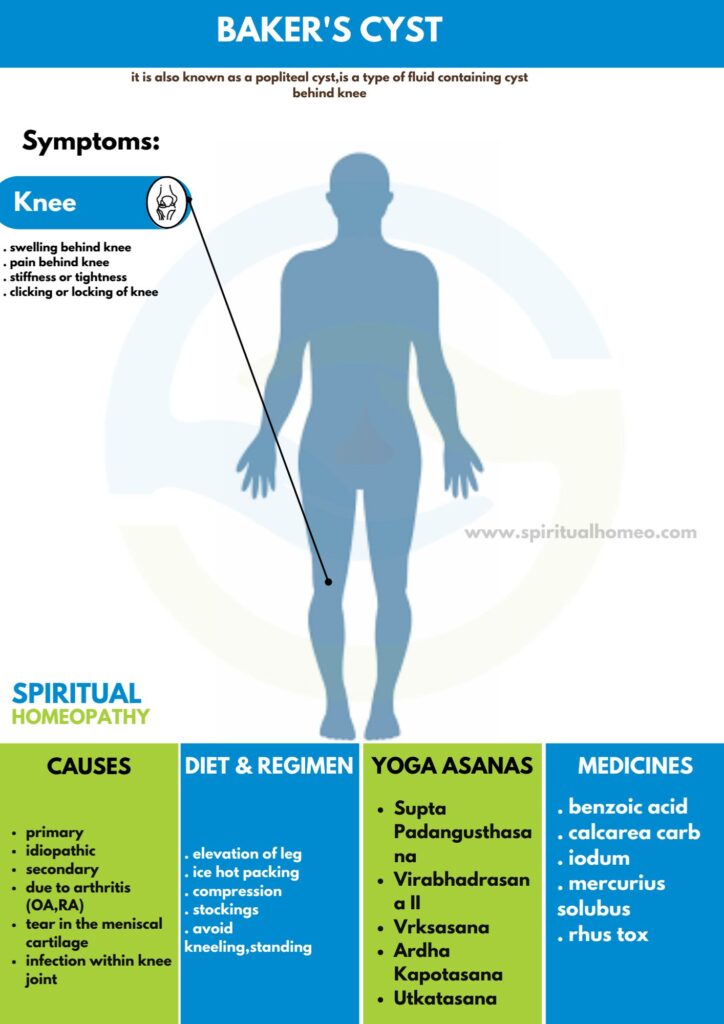
A Baker’s cyst, also known as a popliteal cyst, is a fluid-filled swelling that develops behind the knee. It usually occurs when excess synovial fluid—the natural lubricant within the knee joint—collects in the semimembranosus or medial gastrocnemius bursa at the back of the knee. This may result from distention of the bursa or herniation of the synovial membrane through the back portion of the knee joint capsule.
Baker’s cysts are most commonly seen in adults aged 35 to 70 and can also occur in children between 4 and 7 years. The condition often develops secondary to underlying knee issues, such as osteoarthritis, rheumatoid arthritis, or meniscal injuries.
The cyst is named after William Morrant Baker, the British surgeon who first described it.
Consultation Note: At Spiritual Homeopathy Clinic, patients can seek professional evaluation at multiple branches across Hyderabad or via online and international consultations for guidance on individualized care and symptom management.
A Baker’s cyst develops when the knee joint produces an excess amount of synovial fluid—the natural lubricant that reduces friction and allows smooth leg movement. This excess fluid can accumulate in the popliteal bursa, a small sac located behind the knee, resulting in a noticeable swelling or cyst.
Common underlying causes include:
Knee joint inflammation, often due to arthritis such as osteoarthritis or rheumatoid arthritis
Knee injuries, particularly cartilage damage or meniscal tears
The cyst typically forms in the space between the medial head of the gastrocnemius and the semimembranosus muscles. In some cases, the synovial membrane may bulge into the popliteal space, creating the fluid-filled sac recognized as a Baker’s cyst.
While a Baker’s cyst itself is not a disease, it usually reflects an underlying knee condition that leads to increased fluid production. Individualized evaluation at Spiritual Homeopathy Clinic—available at multiple Hyderabad branches or via online and international consultations—can help identify the cause and guide appropriate care.
Understanding the types of Baker’s cyst helps in identifying the underlying cause and guiding appropriate care. There are two main types:
Primary Baker’s Cyst
Also called idiopathic Baker’s cyst, this type generally develops without any significant underlying knee condition. It is more commonly observed in younger individuals and children. Primary cysts may form due to mild joint irritation or increased synovial fluid production, even when the knee structure is otherwise normal.
Secondary Baker’s Cyst
This is the most common type of Baker’s cyst and is typically linked to underlying joint problems. It often occurs in adults between the ages of 35 and 70. Secondary cysts develop due to conditions that cause joint inflammation or damage, such as:
Osteoarthritis
Rheumatoid arthritis
Meniscus (cartilage) tears
Knee joint injuries or trauma
In these cases, the excess synovial fluid collects in the popliteal bursa, forming a cyst at the back of the knee. Evaluation at Spiritual Homeopathy Clinic, available at multiple Hyderabad branches or via online and international consultations, can help determine the type and guide individualized care.
A Baker’s cyst, also called a popliteal cyst, may develop quietly but can sometimes lead to noticeable discomfort and functional limitations around the knee. Common signs and symptoms include:
Swelling Behind the Knee: A visible or palpable lump at the back of the knee, which may vary in size.
Knee Pain or Discomfort: Pain may increase with activity, particularly when standing for long periods or fully extending the leg.
Stiffness and Tightness: A sensation of tightness or stiffness behind the knee, often more noticeable when bending or straightening the knee.
Clicking or Locking Sensation: Some individuals may feel the knee locking or clicking during movement.
Swelling in the Calf: In larger cysts or if the cyst ruptures, fluid can track down the leg, causing calf swelling that can resemble a blood clot.
Bruising Below the Ankle: Rarely, a burst cyst may lead to fluid accumulation and bruising near the inner ankle (medial malleolus).
Symptoms can vary depending on the cyst’s size and any underlying knee condition. Consult a healthcare professional if swelling, pain, or mobility issues are persistent, worsening, or affecting daily activities. Spiritual Homeopathy Clinic offers in-clinic consultations across Hyderabad and online or international consultations for patients who cannot visit in person.
Managing a Baker’s cyst (popliteal cyst) involves a combination of activity modifications, supportive exercises, and attention to overall joint health. Proper lifestyle habits can help reduce discomfort and support knee function.
To minimize pressure on the knee and reduce inflammation, avoid activities that may aggravate the cyst, such as:
Squatting or Kneeling: These positions place direct pressure on the knee and can worsen swelling.
Heavy Lifting and Climbing Stairs: These actions may strain the knee and increase pain.
High-Impact Exercises (e.g., Running): Repeated impact can further irritate the joint or enlarge the cyst.
Instead, focus on low-impact activities like walking, swimming, or cycling under professional guidance, which maintain joint mobility without excessive stress.
Targeted exercises can relieve tension and strengthen the muscles around the knee. A physiotherapist can guide you through:
Quadriceps Strengthening: Supports knee stability and reduces joint load.
Hamstring and Calf Stretching: Improves flexibility and circulation around the joint.
Patellar Ligament Conditioning: Strengthens muscles around the kneecap to support knee mechanics and minimize fluid buildup.
While diet does not directly reduce the cyst, supporting overall joint health and managing inflammation may help relieve symptoms:
Include Anti-inflammatory Foods: Fatty fish (e.g., salmon), leafy greens, turmeric, ginger, berries, and nuts.
Stay Hydrated: Adequate water intake supports joint lubrication and helps manage swelling.
Limit Processed Foods and Sugars: These can contribute to systemic inflammation and worsen joint discomfort.
While yoga cannot directly cure a Baker’s cyst, gentle stretching and strengthening postures may help relieve tension around the knee, improve flexibility, and support lymphatic drainage—potentially easing discomfort. It is important to avoid deep knee bends or poses that overstrain the joint.
Gentle and Supportive Yoga Asanas:
Supta Padangusthasana (Reclining Hand-to-Big-Toe Pose)
Benefits: Gently stretches the hamstrings and calves without putting pressure on the knee.
How to: Lie on your back, raise one leg, and hold your big toe (or use a strap). Keep the other leg grounded. Hold for 30 seconds to 1 minute.
Viparita Karani (Legs-Up-the-Wall Pose)
Benefits: Supports blood and lymph flow, helping reduce swelling and pressure in the lower limbs.
How to: Lie on your back with your legs resting against a wall. Relax and breathe deeply for 5–10 minutes.
Setu Bandhasana (Bridge Pose)
Benefits: Strengthens the glutes and hamstrings while gently stretching the front of the body.
Caution: Keep knees aligned with hips; avoid overarch of the back or excess strain on the knees.
Tadasana (Mountain Pose)
Benefits: Improves posture and strengthens legs without deep bending.
How to: Stand tall with feet together, arms at your sides, and engage thighs while grounding the feet.
Ananda Balasana (Happy Baby Pose)
Benefits: Opens the hips and gently stretches the legs without compressing the knee joint.
Tip: Modify by holding behind the knees instead of the feet if needed.
Cautions:
Avoid deep squats, full kneeling poses (like Vajrasana), and intense lunges that increase pressure on the cyst.
Always consult your physiotherapist or orthopedic doctor before beginning any yoga or exercise routine.
At Spiritual Homeopathy Clinic, we follow a holistic and individualized approach to wellness, combining classical homeopathy principles with an understanding of physical, emotional, and lifestyle factors. Our goal is to address the underlying causes of a Baker’s cyst and support the body’s natural balance—gently and responsibly.
Our Approach Includes:
Root Cause Assessment: We evaluate the factors contributing to a Baker’s cyst, including joint inflammation, stress on the knee, and overall musculoskeletal or systemic imbalances.
Individualized Remedies: Homeopathic remedies are chosen based on your unique constitution, symptoms, and health history to help manage swelling, relieve discomfort, and support long-term joint health.
Mind-Body Considerations: Emotional and lifestyle factors are considered to support overall well-being and complement the physical aspects of care.
Consultation and Care:
Comprehensive evaluations are available at multiple Hyderabad branches, as well as through online and international consultations for patients who cannot attend in person.
Ongoing monitoring and follow-ups allow for adjustments in care according to individual progress.
Treatment focuses on long-term management, addressing contributing factors and supporting joint function.
You should consult a healthcare professional if swelling, pain, or stiffness behind the knee becomes persistent, worsens with activity, or affects your daily movements. Early evaluation helps identify any underlying joint issues and supports an individualized care plan.
Seek consultation if you experience:
Noticeable or increasing swelling behind the knee
Knee pain that worsens with standing, walking, or bending
Stiffness or difficulty fully extending or bending the knee
Calf swelling, bruising, or redness (especially if sudden or severe)
Symptoms that do not improve with rest, gentle exercises, or lifestyle adjustments
At Spiritual Homeopathy Clinic, consultations are available at multiple branches in Hyderabad, including Kukatpally, Chandanagar, Dilsukhnagar, and Nallagandla. Online and international consultations are also available for patients who cannot visit in person. A professional assessment helps guide individualized care and long-term management of Baker’s cyst.
For appointments or guidance, contact 9069 176 176.
1. What is a Baker’s Cyst?
A Baker’s cyst, also called a popliteal cyst, is a fluid-filled swelling that develops behind the knee. It occurs when excess synovial fluid—the natural lubricant of the knee—accumulates, causing a bulge in the popliteal area. This often arises due to underlying joint conditions or knee injuries.
2. What are the common symptoms of a Baker’s Cyst?
Symptoms may vary depending on cyst size and underlying issues, and commonly include:
Noticeable swelling or lump behind the knee
Pain or discomfort, especially when bending or extending the knee
Stiffness or tightness in the knee joint
Clicking or locking sensations during movement
Calf swelling if the cyst enlarges or ruptures
Occasional bruising in the lower leg due to cyst fluid leakage
If symptoms are frequent, worsening, or affect daily activity, it’s advisable to consult a healthcare professional.
3. What causes a Baker’s Cyst?
Baker’s cysts typically result from:
Knee joint inflammation, such as osteoarthritis or rheumatoid arthritis
Knee injuries, particularly meniscal cartilage tears
Chronic stress or repetitive strain leading to excessive joint fluid
Understanding the underlying cause helps guide individualized care and symptom management.
4. How does homeopathy help with a Baker’s Cyst?
Homeopathy offers a holistic approach, focusing on underlying factors rather than only the swelling. At Spiritual Homeopathy Clinic, treatment is tailored to each individual, addressing inflammation, fluid imbalance, and tissue health. This individualized care approach aims to reduce discomfort, support joint function, and assist in long-term management—while being generally well-tolerated under professional guidance.
5. Can a Baker’s Cyst resolve on its own?
In some cases, smaller cysts may reduce naturally if the underlying joint issue improves. However, persistent or symptomatic cysts should be evaluated by a healthcare professional to rule out complications and develop a management plan.
WhatsApp us