
Hair fall is one of the most common concerns affecting both men and women. Healthy hair growth depends on the normal functioning of hair follicles, proper nutrition, genetics, and hormonal balance. The human body has two main types of hair: vellus hair, which is fine, soft, and light-colored, and terminal hair, which is thicker, longer, and darker. Hormones called androgens play an important role in determining how hair grows and develops. In some people, hormonal changes can cause thick terminal hair to gradually become thinner and finer, leading to increased hair fall and conditions such as androgenetic alopecia (pattern hair loss). Early evaluation and appropriate hair fall treatment can help identify the underlying cause and support healthier hair growth.
At Spiritual Homeopathy, we believe in treating the root cause rather than simply managing hair fall. Our experienced homeopathic doctors carefully evaluate each patient’s symptoms, medical history, hormonal health, nutritional status, stress levels, lifestyle, and overall well-being before preparing an individualized treatment plan. Our holistic approach focuses on supporting healthy hair follicles, improving scalp health, addressing hormonal and nutritional imbalances, reducing excessive hair fall, and promoting long-term hair wellness through safe and personalized homeopathic care. We provide individualized homeopathic treatment for hair fall with a patient-centered approach tailored to each person’s unique needs.
We provide personalized homeopathic treatment for hair fall in Hyderabad to patients of all age groups through our clinics in Hyderabad, as well as online homeopathy consultations for patients across India and in more than 100 countries worldwide. If you are looking for the best homeopathy doctor for hair fall, natural hair loss treatment, support for androgenetic alopecia, or long-term hair health, Spiritual Homeopathy is committed to delivering expert, patient-centered care wherever you are.
Understanding hair structure is essential to identifying factors that affect its growth, health, and vulnerability to damage. The visible part of hair, the hair shaft, is composed entirely of dead protein, primarily keratin.
Hair growth begins in the hair matrix at the base of the follicle. These living cells multiply rapidly—faster than most other cells in the body. As they move upward through the follicular canal, they undergo keratinization, a process of dehydration and hardening, forming a cylindrical shaft of compact keratinized cells.
Normal hair typically has a pointed tip and uniform diameter.
Short hairs with tapered tips may indicate a short growth cycle or recent entry into the active growth phase, called anagen.
The hair shaft has three main layers:
1. Cuticle
Outermost protective layer
Composed of overlapping scale-like cells
Shields the cortex and maintains structural integrity
Damage from excessive brushing or chemical treatments can lead to split ends
2. Cortex
Thickest layer beneath the cuticle
Contains tightly packed keratin proteins and pigment granules
Determines hair strength, texture, and color
3. Medulla (optional)
Innermost core, present in some hair types
Contains softer keratin and varies with hair thickness
The growing hair shaft is enclosed by concentric follicle layers:
Outer Root Sheath
Outermost layer, rich in glycogen
Continuous with the epidermis and provides structural support
Inner Root Sheath
Includes Henle’s layer, Huxley’s layer, and inner sheath cuticle
Appears gelatinous when hair is plucked
Protects the growing hair but breaks down before the shaft emerges from the skin (infundibulum)
Hair color is determined by melanosomes, pigment-containing organelles formed in the bulb matrix and deposited into the cortex and medulla.
Factors such as systemic illness, stress, or certain medications can disrupt protein production in the cortex, potentially leading to weaker, thinner hair shafts.
Note: If hair thinning, breakage, or unusual shedding occurs, professional evaluation is recommended. Spiritual Homeopathy Clinic offers in-clinic, online, and international consultations to assess hair health and guide individualized care.
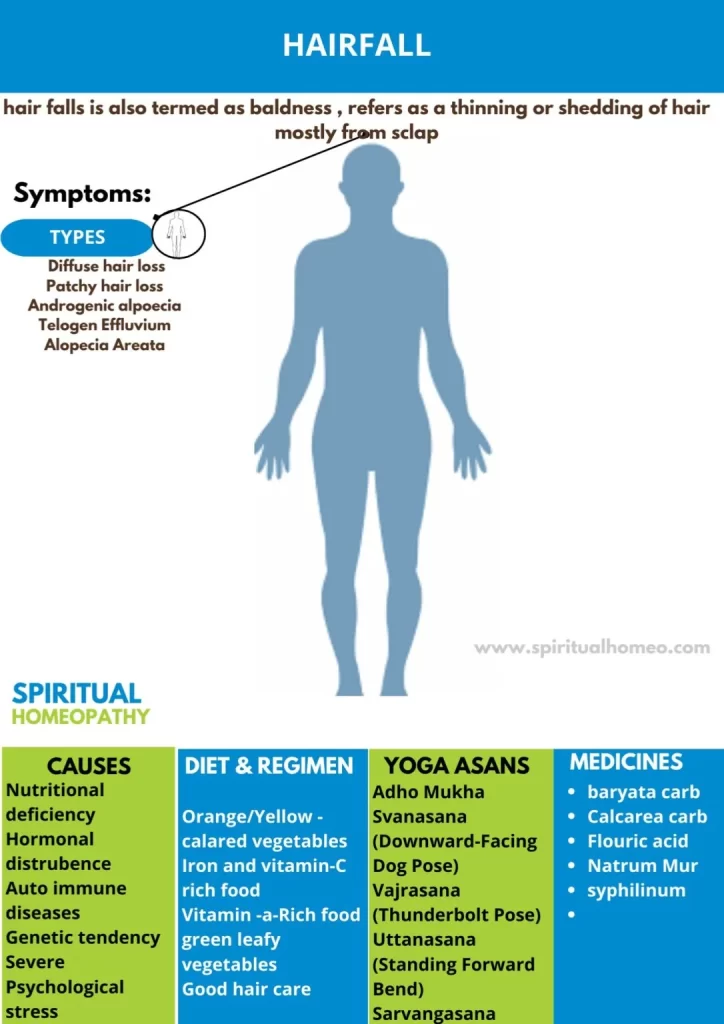
Hair fall, or alopecia, can arise from a combination of genetic, medical, nutritional, and environmental factors. Identifying the underlying cause is essential for accurate assessment and individualized care. At Spiritual Homeopathy Clinic, in-clinic, online, and international consultations are available to evaluate the cause of hair loss and recommend a personalized approach.
The most common form of hair loss in both men and women is androgenetic alopecia, also known as pattern baldness. This condition is inherited and linked to sensitivity to dihydrotestosterone (DHT), a byproduct of testosterone.
In susceptible individuals, DHT binds to hair follicles, causing them to shrink gradually.
This leads to thinner, shorter hairs and may eventually stop new hair from growing.
Not all hair loss is hereditary. Common non-genetic causes include:
Diffuse Non-Scarring Hair Loss
Androgenetic alopecia
Telogen effluvium (stress-related shedding)
Systemic conditions such as thyroid disorders, anemia, or dermatitis
Patchy Scarring Hair Loss
Folliculitis (bacterial infection)
Lichen planopilaris
Discoid lupus erythematosus
Patchy Non-Scarring Hair Loss
Tinea capitis (scalp ringworm)
Trichotillomania (compulsive hair pulling)
Traction alopecia (from tight hairstyles)
Syphilis
Autoimmune conditions can cause the immune system to attack hair follicles:
Alopecia Areata: Sudden, patchy hair loss; may progress to total scalp or full-body hair loss. Regrowth is possible since follicle structure remains intact.
Lupus Erythematosus: Can affect the follicle’s bulge area, potentially leading to scarring and permanent hair loss if untreated.
Hair loss may result from various infections and medical conditions:
Fungal infections: ringworm, kerion, favus
Bacterial infections: folliculitis, furuncles
Chronic skin conditions: eczema, psoriasis, lichen planopilaris
Skin cancers (e.g., basal cell carcinoma)
Endocrine disorders: hypothyroidism, hypopituitarism
Systemic illnesses: leprosy, syphilis, shingles
Poor nutrition can contribute to hair thinning, especially in women:
Iron Deficiency Anemia: Often caused by low dietary iron, poor absorption, or chronic blood loss. Serum ferritin levels below 70 ng/mL may increase hair fall.
Other contributors: crash dieting, anorexia, or bulimia
Certain toxins can trigger hair loss:
Heavy metals: arsenic, mercury, thallium, cadmium, gold
Excessive vitamin A intake
Boric acid and some pesticides
Medications such as warfarin
Some medications list hair loss as a side effect:
Chemotherapy agents
Anticoagulants (blood thinners)
Antidepressants, beta-blockers, retinoids
Hair usually regrows after stopping the drug unless permanent follicle damage occurs.
Radiation therapy to the scalp can cause localized hair loss. Regrowth may occur in 3–4 months, but high doses may lead to permanent baldness.
Severe emotional or physical stress—such as surgery, childbirth, major illness, trauma, or sudden weight loss—can prematurely push hair follicles into the resting (telogen) phase. Hair usually regrows over months, but repeated episodes can reduce hair density over time.
Note: Persistent, severe, or recurrent hair fall warrants professional assessment. Spiritual Homeopathy Clinic provides tailored evaluation and individualized homeopathy consultation for patients in Hyderabad and internationally.
Pattern:
Men: Receding hairline and thinning at the crown
Women: Diffuse thinning over the crown with widening of the part
Cause: Genetics and increased sensitivity to DHT (dihydrotestosterone)
Typical Onset: Can begin in the late teens or early 20s
Progression: Gradual and permanent if untreated
Treatment Options: Minoxidil, finasteride, low-level laser therapy, PRP, and hair transplant surgery
Pattern: Sudden and diffuse hair shedding across the scalp
Cause: Triggered by physical or emotional stress, surgery, illness, childbirth, medications, or nutritional deficiencies
Recovery: Usually temporary; hair regrowth typically occurs within 3 to 6 months once the trigger is resolved
Treatment Options: Address underlying cause, stress management, nutritional support
Pattern: Patchy hair loss with smooth, round bald spots
Cause: Autoimmune disorder—immune system attacks hair follicles
Variants:
Alopecia Totalis: Loss of all scalp hair
Alopecia Universalis: Loss of all body hair
Prognosis: Hair may regrow spontaneously or with treatment, but relapses are common
Treatment Options: Corticosteroid injections, topical immunotherapy, JAK inhibitors
Pattern: Hair loss around the hairline or areas under tension
Cause: Repeated pulling from tight hairstyles like ponytails, braids, buns, or hair extensions
Reversibility: Reversible in early stages; permanent damage if prolonged
Treatment Options: Loosen hairstyles, protective styles, topical treatments, hair restoration in advanced cases
Pattern: Rapid and widespread hair loss during the active growth phase
Cause: Chemotherapy, radiation therapy, or exposure to toxins
Onset: Sudden and often dramatic
Recovery: Hair usually regrows once treatment ends
Treatment Options: Cooling caps during chemotherapy, scalp care, and post-treatment recovery support
Pattern: Permanent hair loss due to inflammation that destroys hair follicles and causes scarring
Cause: Inflammatory skin conditions such as lupus, lichen planopilaris, and discoid lupus
Diagnosis: Requires scalp biopsy and evaluation by a dermatologist
Treatment Options: Anti-inflammatory medications, corticosteroids, and early medical intervention to prevent further loss
Pattern: Irregular patches of hair loss due to compulsive hair pulling
Cause: Psychological condition classified as an impulse control disorder
Associated Conditions: Anxiety, OCD, or trauma
Treatment Options: Behavioral therapy, psychological counseling, and sometimes medication
Experiencing hair loss can be distressing, and accurate diagnosis is essential for effective management. Spiritual Homeopathy Clinic offers in-clinic consultations across multiple Hyderabad branches and online consultations for international patients, allowing for individualized assessment and guidance.
Thinning Hair: Gradual reduction in volume, often noticeable at the crown or along the part line
Receding Hairline: Frequently observed in men with pattern baldness
Patchy Hair Loss: Circular or irregular bald patches, common in alopecia areata
Broken or Fragile Hair: May indicate structural hair disorders or nutritional deficiencies
Scalp Symptoms: Itching, redness, scaling, or inflammation may suggest underlying scalp conditions or infections
Tip: Frequent or worsening hair loss should prompt professional consultation.
Purpose: Assesses hair structure, thickness, and abnormalities
Method:
Select 25–30 hairs close to the scalp
Place between wet microscope slides for magnification
Useful For: Detecting structural disorders, hair breakage, or miniaturization linked to pattern baldness
Purpose: Checks if hair is actively growing
Method:
Trim or shave a small scalp section (~2 cm)
Re-examine after 1–4 weeks for regrowth
Normal Growth: Approximately 1 cm per month
Use: Helps confirm regrowth in cases of stress-related or temporary shedding
Purpose: Evaluates hair root health and growth cycles
Method:
Pluck ~50 hairs using gentle forceps
Examine roots under magnification
Observations:
Telogen hairs: small, non-pigmented bulbs
Anagen hairs: large, pigmented bulbs with gelatinous sheath
Use: Identifies hair cycle disorders, telogen effluvium, or treatment-related shedding
Relevance: Hormonal imbalances often contribute to hair loss, especially in women
Common Tests: Prolactin, Testosterone, DHEA, LH, FSH
Use: Detects conditions like PCOS or androgen-related hair thinning
Relevance: Thyroid imbalances can affect hair texture, strength, and growth
Common Tests: T3, T4, TSH
Use: Identifies hypothyroidism or hyperthyroidism linked to hair loss
Relevance: Iron deficiency is a frequent contributor to hair fall
Tests: Serum Iron and Serum Ferritin
Note: Ferritin levels below 70 ng/mL may indicate increased risk of shedding or telogen effluvium
Purpose: Evaluates overall blood health and detects systemic contributors
Use: Can reveal anemia, infections, or immune-related conditions that may cause diffuse or patchy hair loss
Note: Diagnostic tests are most effective when combined with a thorough clinical evaluation. Spiritual Homeopathy Clinic provides professional guidance to interpret results and plan individualized care.
Healthy hair starts from within. Nutritional choices have a direct impact on hair strength, shine, and growth. At Spiritual Homeopathy Clinic, we emphasize that dietary guidance should complement professional care, tailored to individual health needs. Online and in-clinic consultations are available to help create personalized nutrition plans.
Biotin (Vitamin B7)
Supports hair growth, volume, and overall hair quality
Deficiency can lead to thinning, dullness, or discoloration
Sources: Whole grains, egg yolk, liver, soybeans, raspberries, cranberries, and yeast
Omega-3 Fatty Acids
Nourish hair follicles, reduce scalp dryness, and support elasticity
Help minimize breakage and inflammation
Sources: Fatty fish (salmon, mackerel, trout), walnuts, avocados, pumpkin seeds
Protein
Hair is made primarily of keratin, a protein; adequate intake strengthens hair
Lack of protein can lead to brittle, weak, or thinning strands
Sources: Chicken, turkey, fish, eggs, dairy; for vegetarians: legumes, tofu, quinoa, nuts
Iron
Essential for oxygen delivery to scalp and hair follicles
Iron deficiency (common in women) is a frequent cause of hair loss
Sources: Red meat, spinach, beetroot, soybeans, lentils, apples, broccoli, seafood (clams)
Vitamin C
Enhances iron absorption and collagen production
Strengthens blood vessels supplying nutrients to follicles
Sources: Oranges, strawberries, papaya, blueberries, sweet potatoes, bell peppers
Vitamin E
Supports scalp circulation and follicle health
Acts as an antioxidant to reduce oxidative stress affecting hair aging
Sources: Nuts (almonds, walnuts), seeds, avocados, spinach, olive oil
Vitamin A
Supports sebum production to maintain a hydrated scalp and shiny hair
Excess intake may contribute to hair loss; balance is important
Sources: Carrots, sweet potatoes, pumpkins, dark leafy greens, apricots, lettuce
Note: Dietary guidance may vary depending on individual health conditions, age, and lifestyle. Professional assessment helps determine the most suitable nutritional plan for your hair health.
Benefits:
Increases blood flow to the scalp
Strengthens arms, shoulders, and spine
Reduces stress and fatigue
How to do it:
Start in a tabletop position.
Lift your hips upward, forming an inverted “V” shape.
Keep your hands and feet firmly on the ground.
Hold for 30 seconds to 1 minute.
Benefits:
Stimulates thyroid glands and scalp blood flow
Improves hormonal balance
Helps in nourishing hair roots
How to do it:
Lie on your back, lift both legs upward.
Support your back with your hands, raising your lower body.
Keep your legs straight up and hold the pose for 30 seconds.
Avoid during menstruation or if you have neck issues.
Benefits:
Enhances digestion, which improves nutrient absorption for hair
Calms the mind and reduces stress
Simple and effective post-meal pose
How to do it:
Sit on your knees with your heels touching your buttocks.
Keep your spine straight and hands on your thighs.
Hold for 5 to 10 minutes daily.
Benefits:
Relieves tension in the back, shoulders, and chest
Calms the nervous system
Gently increases blood circulation to the scalp
How to do it:
Sit on your knees and fold your body forward.
Rest your forehead on the floor and stretch your arms forward.
Stay in this position for 1–2 minutes.
Benefits:
Directs blood flow to the head
Stimulates hair follicles
Reduces fatigue and anxiety
How to do it:
Stand with feet hip-width apart.
Bend forward from the hips and try to touch your toes.
Let your head hang freely, and breathe deeply for 30–60 seconds.
Benefits:
Detoxifies the body
Improves oxygen supply to the scalp
Helps with hormonal balance
How to do it:
Sit in a comfortable position.
Exhale forcefully through your nose while contracting your abdomen.
Do 30 short, forceful breaths followed by a deep inhale.
Avoid if you’re pregnant or have heart issues.
Benefits:
Reduces anxiety and stress levels
Balances hormone secretion
Promotes healthy hair growth by calming the nervous system
How to do it:
Close your right nostril with your thumb and inhale through your left.
Close your left nostril with your ring finger and exhale through the right.
Repeat for 5–10 minutes daily.
Homeopathy is a gentle, natural system of care that focuses on addressing the underlying causes of hair loss rather than just the symptoms. It works in harmony with your body’s natural processes, supporting healthy hair growth and scalp function. Homeopathic care is individualized, safe for all ages, and generally well-tolerated under professional guidance.
Whether hair fall is acute, chronic, stress-related, or linked to nutritional or hormonal factors, homeopathy provides a holistic approach to long-term hair health.
At Spiritual Homeopathy Clinic, we emphasize a personalized, root-cause approach to hair loss. Our goal is to identify contributing factors—such as stress, hormonal imbalances, nutrition, or scalp conditions—and address them through individualized care plans.
What Sets Us Apart:
Root-Cause Approach: Focus on the underlying factors of hair loss, not just surface symptoms.
Personalized Care: Treatment plans are tailored to your hair type, lifestyle, and overall health.
Experienced Team: Skilled homeopathy doctors in Hyderabad provide in-clinic, online, and international consultations.
Safe & Gentle: Remedies are non-toxic and designed to support your body’s natural healing.
Holistic Support: Mind-body balance and lifestyle guidance are integrated into the treatment plan.
Detailed Consultation
We assess your hair loss pattern, lifestyle, medical history, and emotional health to design a customized care plan.
Individualized Homeopathic Care
Remedies and supportive guidance are selected based on the type and underlying cause of hair loss.
Ongoing Monitoring & Support
Regular follow-ups help track progress, adjust treatment, and provide practical lifestyle or dietary advice.
At Spiritual Homeopathy Clinic, we offer consultations at multiple Hyderabad branches including Kukatpally, Chandanagar, Dilsukhnagar, and Nallagandla, as well as online and international consultations. For personalized guidance or appointments.
You should consult a healthcare professional if hair fall becomes frequent, sudden, or begins to affect your confidence or daily routine. Early evaluation helps identify underlying causes and guides individualized care.
Seek consultation if you experience:
Rapid or excessive hair shedding
Sudden patchy hair loss or bald spots
Hair thinning along the hairline or crown
Scalp irritation, redness, or itching
Noticeable hair breakage or brittle strands
Hair loss associated with systemic symptoms such as fatigue, weight changes, or hormonal imbalance
Hair loss that does not improve with dietary adjustments or lifestyle measures
At Spiritual Homeopathy Clinic, consultations are available at multiple branches in Hyderabad, including Kukatpally, Chandanagar, Dilsukhnagar, and Nallagandla. Online and international consultations are also offered for patients unable to visit in person. A professional assessment ensures an individualized care plan tailored to your symptoms, hair condition, and overall health.
For appointments or guidance, call 9069 176 176.
To stop hair fall immediately, switch to a gentle, sulfate-free shampoo, air-dry hair instead of using high heat, and avoid tight hairstyles like ponytails. For long-term results, you can apply over-the-counter treatments like to stimulate follicles, ensure your diet includes adequate iron and protein, and manage your stress levels.
The primary cause of hair loss is hereditary genetics (androgenetic alopecia). Also known as male- or female-pattern baldness, it causes a predictable receding hairline or general thinning. Other major triggers include hormonal fluctuations, severe stress, nutritional deficiencies, and autoimmune conditions.
Losing 200 hairs a day can sometimes be normal if you wash your hair infrequently (allowing the strands to build up), have very long hair, or just went through a major physiological change. However, if it's a persistent daily occurrence, it usually exceeds the standard 50–150 strands most adults shed daily.
Type 3 hair loss refers to Stage 3 on the Norwood Scale, which is clinically considered the first official stage of male pattern baldness. It is characterized by deep, symmetrical recession at the temples—often forming an "M", "U", or "V" shape—or noticeable thinning at the crown.
To stop hair fall, prioritize a balanced diet rich in protein, iron, zinc, and vitamins. Key foods include eggs (protein and biotin), fatty fish like salmon (Omega-3s), spinach (iron and vitamins), Greek yogurt (protein and B5), and lentils or beans. These nourish follicles and promote scalp health.
Shampoo rarely causes true hair loss, but harsh chemicals, allergic reactions, or improper use can trigger scalp irritation and severe hair breakage. True hair loss typically stems from internal factors like genetics, hormones, or nutritional deficiencies.