
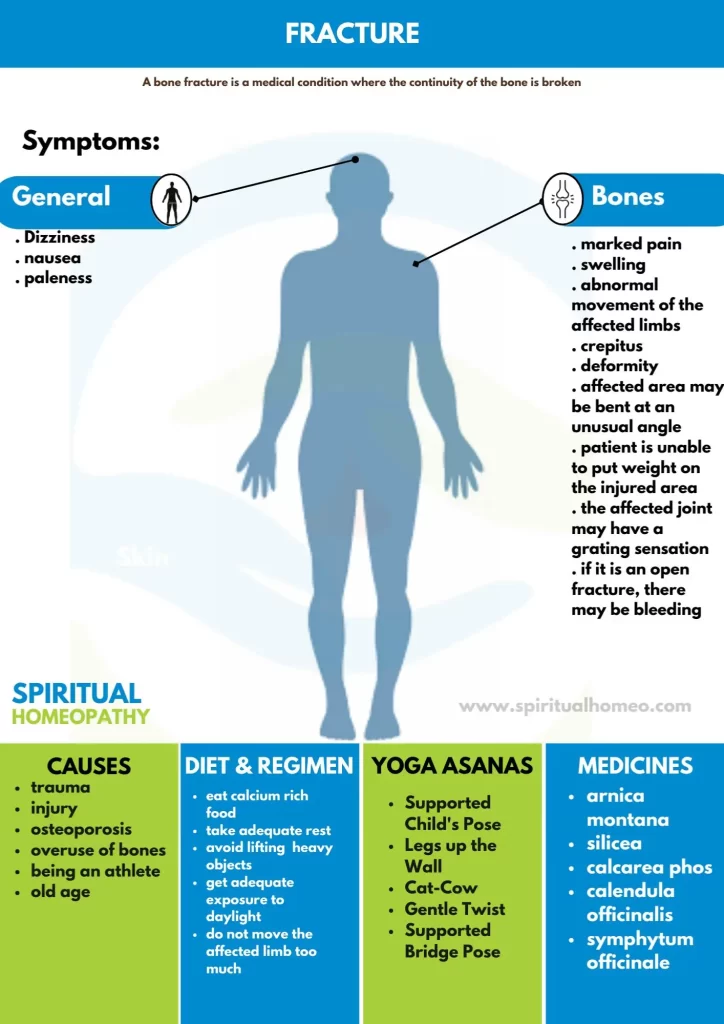
A bone fracture is a medical condition in which the continuity of a bone is partially or completely broken. Fractures can occur due to falls, road accidents, sports injuries, osteoporosis, or direct trauma to the bone. Common symptoms include severe pain, swelling, bruising, difficulty moving the affected area, deformity, and an inability to bear weight on the injured limb. While fractures usually require appropriate orthopedic evaluation and stabilization, proper follow-up care and rehabilitation are important for healthy bone healing and recovery. Seeking timely medical attention can help reduce the risk of complications and support a smoother recovery process.
At Spiritual Homeopathy, we believe in supporting the body’s natural healing process while focusing on the individual’s overall health rather than only addressing symptoms. Our experienced homeopathic doctors carefully evaluate each patient’s medical history, injury details, general health, lifestyle, and recovery progress before preparing a personalized treatment plan. Our holistic approach aims to support overall well-being, promote healthy recovery, help manage discomfort, and improve mobility through safe and individualized homeopathic care. Homeopathy may be used as a complementary approach alongside conventional fracture management under appropriate medical guidance.
We provide personalized homeopathic care for fracture recovery in Hyderabad to patients of all age groups through our clinics in Hyderabad, as well as online homeopathy consultations for patients across India and in more than 100 countries worldwide. If you are looking for experienced homeopathic doctors to support your recovery after a fracture and improve your overall healing journey, Spiritual Homeopathy is committed to delivering expert, patient-centered care wherever you are.
Bone fractures commonly occur in individuals with weakened bones, such as those affected by osteoporosis, but they can also happen in conditions like osteopenia or even in otherwise healthy bones under significant stress. Many fractures result from falls, accidents, or high-impact forces, making them a frequent concern in older adults.
At Spiritual Homeopathy Clinic, consultations are available at multiple branches in Hyderabad, as well as online and international consultations for patients who cannot visit in person. A professional assessment helps guide an individualized care approach based on bone health and overall medical history.
Stress Fractures:
These fractures are more common among athletes and result from repeated stress or strain on the bone. Over time, constant pressure can cause the bone to crack.
Torus (Buckle) Fractures:
Typically seen in children, this fracture occurs when the bone deforms but does not completely break. While it can be painful, it is generally stable and heals well with proper care.
Transverse Fractures:
A transverse fracture is a straight break occurring directly across the bone, often caused by a direct impact or force.
Other Contributing Factors:
Bone fractures can also be influenced by conditions like osteoporosis, nutritional deficiencies, or previous injuries. Understanding the underlying cause is important for individualized care and management, which can be assessed during consultations at Spiritual Homeopathy Clinic, available at multiple Hyderabad branches as well as online and international consultations.
Bone fractures can occur in various forms, each with unique characteristics. Below are the common types of fractures:
Closed Fracture:
The bone breaks but does not damage surrounding tissue or pierce the skin.
Compound (Open) Fracture:
The bone breaks and protrudes through the skin, increasing the risk of infection.
Avulsion Fracture:
Occurs when a muscle or ligament pulls on the bone, causing a fracture.
Comminuted Fracture:
The bone shatters into multiple pieces, often due to significant trauma or impact.
Compression (Crush) Fracture:
Common in the spine, especially in the vertebrae, where the bone may collapse, often linked to conditions like osteoporosis.
Fracture with Dislocation:
A joint is forced out of position, and one of the bones involved is fractured.
Greenstick Fracture:
Part of the bone breaks while the other side remains intact; more common in children due to flexible bones.
Hairline Fracture:
A small, partial break that may be difficult to detect on routine X-rays.
Impacted Fracture:
One bone fragment is driven into another, often caused by a fall or heavy impact.
Intra-Articular Fracture:
Extends into the joint surface, potentially affecting joint mobility and function.
Longitudinal Fracture:
Runs along the length of the bone, typically caused by a force along the bone’s axis.
Oblique Fracture:
Occurs diagonally across the bone, often from a bending force.
Pathological Fracture:
Results from an underlying condition that weakens the bone, making it prone to breakage.
Spiral Fracture:
The bone twists, creating a spiral break, usually from a twisting motion or trauma.
Stress Fracture:
Caused by repeated stress or overuse, particularly in weight-bearing bones, common among athletes.
Torus (Buckle) Fracture:
Mostly seen in children, where the bone deforms but does not completely break; typically stable and heals well.
Transverse Fracture:
A straight break across the bone, usually from a direct impact or force.
Proper evaluation and individualized care are essential for healing, which can be guided through consultations at Spiritual Homeopathy Clinic, available at multiple Hyderabad branches as well as online and international consultations. Early assessment supports tailored management and monitoring for optimal recovery.
Bone fractures typically present with localized pain that worsens with movement of the affected area or limb. The pain is often sharp and intense. While fractures commonly follow trauma, they can also occur spontaneously in individuals with severe osteoporosis or other bone conditions.
Common signs and symptoms include:
Localized Bone Pain: Severe pain that increases with movement or pressure on the affected bone.
History of Trauma: Fractures often result from falls, impacts, or accidents, but in conditions like osteoporosis, fractures can occur with minimal or no trauma.
Swelling: The injured area may swell due to internal bleeding or inflammation around the fracture.
Abnormal Movement: Limited mobility or unusual movement of the affected limb due to bone displacement.
Crepitus: A grating or cracking sound may be felt or heard when moving the bone, indicating friction between broken fragments.
Deformity: The bone or joint may appear misaligned, bent, or out of its normal position.
Angulation: The fractured limb or bone may be abnormally angled.
Inability to Bear Weight: Difficulty or inability to put weight on affected bones, particularly in the legs.
Bleeding (in Open Fractures): Visible bleeding occurs if the bone pierces the skin.
Femoral Neck Fractures: The leg may appear shortened and externally rotated, with severe pain aggravated by movement.
Fragility Fractures:
Precipitating Factor: Fall from standing height or less
Associated Conditions: Osteoporosis, Osteopenia
Vertebral Fractures:
Precipitating Factor: Bending, lifting, or minor falls
Associated Conditions: Osteoporosis
Stress Fractures:
Precipitating Factor: Repetitive activity like running or excessive training
Associated Conditions: Often occur in otherwise healthy bones
High-Energy Fractures:
Precipitating Factor: Major trauma or accidents
Associated Conditions: Usually in individuals with normal bone health
Pathological Fractures:
Precipitating Factor: Minimal trauma or spontaneous
Associated Conditions: Malignancy, Paget’s disease, Osteomalacia
Frequent, severe, or unusual symptoms warrant professional evaluation. Spiritual Homeopathy Clinic offers consultations at multiple branches in Hyderabad, as well as online and international options, to provide individualized assessment and guidance for long-term bone health.
Immediate assessment is essential to ensure proper management, prevent complications, and support optimal recovery.
Supporting bone recovery after a fracture requires proper nutrition to aid tissue repair and bone strength:
Calcium-rich Foods: Dairy products, leafy green vegetables, and calcium-fortified plant-based milks help maintain bone density.
Vitamin D: Fatty fish like salmon, egg yolks, and fortified foods enhance calcium absorption, supporting bone repair.
Protein: Lean meats, tofu, legumes, and nuts provide building blocks for tissue repair and muscle recovery.
Magnesium: Whole grains, seeds, and leafy greens are important for maintaining healthy bones.
Vitamin C: Citrus fruits, strawberries, and bell peppers support collagen formation, essential for tissue healing.
Zinc: Meat, shellfish, legumes, and seeds contribute to effective tissue regeneration.
Healthy Fats: Omega-3-rich foods, such as salmon and chia seeds, may help reduce inflammation and promote recovery.
Nutritional guidance may vary based on age, underlying conditions, or specific fracture type. A professional consultation can help tailor your diet to your individual needs.
Alongside a nutritious diet, a structured daily regimen supports proper fracture recovery:
Rest and Immobilization: Follow your healthcare provider’s advice regarding casts, splints, or braces to allow the bone to heal correctly.
Gentle Movement: Gradually introduce physiotherapy or stretching exercises as recommended to restore mobility without straining the healing bone.
Hydration: Regular water intake supports tissue repair and overall recovery.
Pain Management: Use prescribed pain relief as directed and avoid overexertion to prevent delays in healing.
Adequate Sleep: Aim for 7–9 hours of restful sleep nightly, as it is essential for tissue regeneration and overall recovery.
Combining a nutrient-rich diet with a carefully monitored healing regimen helps the body recover efficiently and supports long-term bone health. Spiritual Homeopathy Clinic provides guidance for individualized care through in-clinic, online, and international consultations.
Yoga can support fracture recovery by promoting gentle movement, flexibility, and strengthening the body. It is essential to consult your healthcare provider before starting any yoga practice after a fracture to ensure it is safe based on your injury and healing progress.
Benefits: Improves posture, enhances balance, and gently strengthens legs and core.
How to Do It:
Stand tall with feet together and arms at your sides.
Engage your legs and lift your chest.
Breathe deeply and hold for 30 seconds to 1 minute.
Benefits: Strengthens legs and improves balance, helping regain stability.
How to Do It:
Stand tall and place one foot against the inner thigh or calf of the other leg.
Bring hands together in prayer position or extend overhead.
Hold for 30 seconds, then switch sides.
Benefits: Stretches hips and groin, improving flexibility and relieving stiffness.
How to Do It:
Sit with legs extended, then bend knees and bring soles of feet together.
Hold your feet and gently press knees toward the floor.
Hold for 30 seconds while breathing deeply.
Benefits: Restorative pose to reduce stress, relax the body, and calm the nervous system.
How to Do It:
Lie flat on your back with arms by your sides.
Close your eyes, focus on breathing, and relax fully.
Stay for 5–10 minutes.
Benefits: Strengthens back, legs, and core; gently opens the chest and spine.
How to Do It:
Lie on your back with knees bent, feet hip-width apart.
Press feet into the floor, lift hips, and keep arms by your sides or interlace fingers under your back.
Hold 15–30 seconds, then lower gently.
Benefits: Increases spinal flexibility, stretches back muscles, and relieves tension.
How to Do It:
Start in tabletop position on hands and knees.
Inhale, drop belly and lift chest (Cow Pose).
Exhale, round spine and bring chin toward chest (Cat Pose).
Repeat 5–10 rounds, moving gently with breath.
Benefits: Stretches hamstrings, calves, and lower back; improves flexibility.
How to Do It:
Stand feet hip-width apart.
Hinge at hips and slowly lower torso, keeping knees slightly bent if needed.
Hold 30 seconds, breathing deeply.
Benefits: Strengthens legs and stretches hips and groin.
How to Do It:
From standing, step one foot forward into a lunge.
Lower back knee, press hips forward, raise arms overhead.
Hold 30 seconds to 1 minute, then switch sides.
Benefits: Gently improves spinal mobility and flexibility, easing back or neck discomfort.
How to Do It:
Begin in tabletop position.
Exhale, round spine and bring chin to chest (Cat Pose).
Inhale, return to neutral or Cow Pose.
Repeat 5–10 rounds.
Avoid overextending or straining the affected area.
Modify or skip poses until cleared by your healthcare provider.
Begin with gentle movements and increase intensity gradually.
Yoga complements fracture recovery but is not a substitute for professional medical care.
Spiritual Homeopathy Clinic offers guidance on integrating supportive yoga practices with individualized care plans for patients recovering from fractures. Consult our in-clinic, online, or international services for personalized advice.
At Spiritual Homeopathy Clinic, we follow a holistic approach that combines traditional homeopathic principles with a comprehensive understanding of overall well-being. Our team of experienced practitioners provides personalized care, ensuring treatment plans are tailored to your individual health needs, including bone health and fracture recovery.
Healing involves restoring balance between the mind, body, and overall health. Our approach focuses on identifying underlying factors contributing to fractures or delayed healing, rather than only addressing symptoms. By supporting your body’s natural recovery processes, we aim to promote long-term bone health and well-being.
Consultations: Our practitioners conduct detailed consultations to assess your health history, fracture type, and recovery needs. In-person consultations are available at multiple branches in Hyderabad, including Kukatpally, Chandanagar, Dilsukhnagar, and Nallagandla. Online and international consultations are also provided for patients who cannot visit in person.
Homeopathic Care: We provide individualized homeopathic support that addresses factors affecting bone healing and overall recovery. Our approach is gentle and generally well-tolerated under professional guidance.
Follow-Up Support: Continuous monitoring and follow-up care are integral to our treatment approach. We track your progress, adjust care plans as needed, and support your recovery journey to restore mobility and strength safely.
Your recovery and long-term bone health are our priorities. At Spiritual Homeopathy, we provide compassionate, individualized care throughout the healing process, ensuring guidance and support at every stage—from initial assessment to post-fracture recovery.
You should seek medical evaluation promptly if you suspect a bone fracture, especially when pain, swelling, or deformity is present. Early assessment helps ensure proper alignment, prevent complications, and support optimal healing.
Seek consultation if you experience:
Severe or persistent bone pain, especially after trauma
Visible deformity, angulation, or abnormal movement in a limb or joint
Inability to bear weight on the affected limb
Swelling, bruising, or tenderness around a bone
Numbness, tingling, or restricted movement near the injury site
Open wounds exposing bone (suspected compound fracture)
At Spiritual Homeopathy Clinic, fracture consultations are available at multiple branches in Hyderabad, including Kukatpally, Chandanagar, Dilsukhnagar, and Nallagandla. Online and international consultations are also offered for patients who cannot visit in person. Professional evaluation ensures an individualized care plan based on the type of fracture, healing stage, and overall health.
For appointments or guidance, contact 9069 176 176.
A fracture is a medical term for a partial or complete break in the continuity of a bone. It occurs when an external physical force (like a fall or car accident) or an underlying medical condition (like osteoporosis) subjects the bone to more stress than it can withstand
The 4 primary types of fractures, categorized by how the bone breaks, are:
To repair bones, the best drinks are packed with calcium, vitamin D, and protein. Excellent options include dairy milk, calcium-fortified plant milks (like soy or almond milk), and vitamin C-rich smoothies made with dark leafy greens and berries.
Prunes are widely considered one of the most powerful fruits for bone health. Research shows eating just 5 to 6 prunes a day can help preserve bone mineral density and reduce bone breakdown, largely thanks to their high concentration of vitamin K, potassium, and boron.
Dairy, fish, leafy greens, nuts, and whole grains contain nutrients for bone healing. Dairy foods and dairy substitutes: Anything made from cow's milk is a good source of calcium and most dairy substitutes, such as almond milk or soymilk, are fortified with calcium.