
Functional enuresis, commonly known as bedwetting, is the repeated involuntary passing of urine, usually during sleep, in children who are old enough to have achieved bladder control and who do not have an underlying medical or structural problem affecting the urinary system. It is a common childhood condition that can be influenced by delayed bladder maturation, deep sleep patterns, family history, emotional stress, or bladder function. Although many children outgrow bedwetting naturally, frequent or persistent episodes can affect a child’s confidence, emotional well-being, and quality of life. Early evaluation and appropriate treatment can help identify contributing factors and provide effective long-term support.
At Spiritual Homeopathy, we believe in treating the root cause rather than simply managing the symptoms. Our experienced homeopathic doctors carefully evaluate each child’s symptoms, medical history, sleep patterns, emotional health, bladder habits, family history, and overall well-being before preparing an individualized treatment plan. Our holistic approach focuses on supporting healthy bladder function, improving overall balance, reducing recurring bedwetting episodes, and promoting long-term wellness through safe and personalized homeopathic care. We provide individualized homeopathic treatment for functional enuresis with a patient-centered approach tailored to each child’s unique needs.
We provide personalized homeopathic treatment for functional enuresis in Hyderabad to children of all age groups through our clinics in Hyderabad, as well as online homeopathy consultations for patients across India and in more than 100 countries worldwide. If you are looking for the best homeopathy doctor for functional enuresis, natural support for bedwetting, or long-term bladder health, Spiritual Homeopathy is committed to delivering expert, patient-centered care wherever you are.
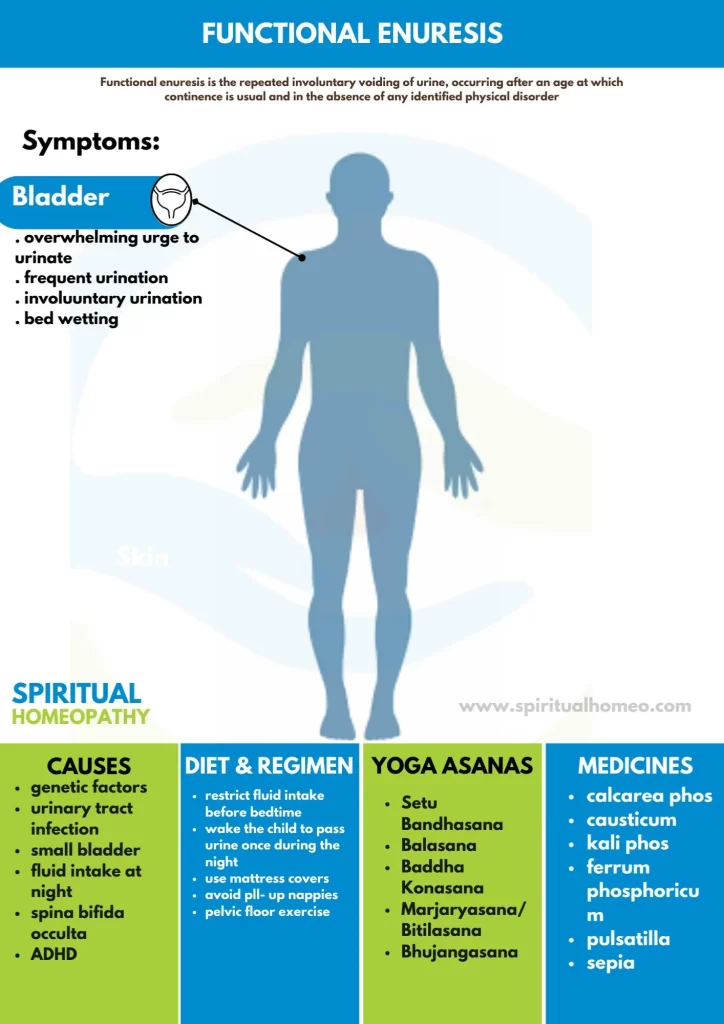
Functional enuresis is a condition in which involuntary urination occurs in children or adults who have otherwise reached the expected age for bladder control. It is commonly categorized into two main types:
Nocturnal Enuresis – bedwetting during sleep
Diurnal Enuresis – involuntary urination during waking hours
Some individuals may experience both forms.
Nocturnal enuresis is further classified as:
Primary enuresis, where the individual has never achieved consistent nighttime bladder control
Secondary enuresis, where bedwetting reappears after a dry period, usually lasting six months or longer
Most children develop reliable daytime and nighttime bladder control between the ages of 3 and 4 years. The age of 5 years is generally considered the minimum age for diagnosing enuresis.
Consultation with a healthcare professional helps assess contributing factors and guide individualized care. At Spiritual Homeopathy Clinic, consultations are available across multiple branches in Hyderabad, as well as through online and international consultation services.
Nocturnal enuresis is relatively common and can be emotionally distressing for both children and parents. Concerns often arise due to embarrassment, social avoidance, or emotional stress related to misunderstanding or inappropriate responses.
Reported prevalence includes:
Around 10% of children at age 5
Approximately 4% at age 8
About 1% by age 14
Nearly 0.5% of cases may persist into adulthood
The condition is more frequently observed in boys with nighttime enuresis, while daytime enuresis is less common and occurs more often in girls.
A supportive and understanding approach, along with professional guidance, can help manage the emotional and physical aspects of enuresis over time.
In most cases of primary nocturnal enuresis (bedwetting during sleep), the exact cause is idiopathic, meaning no clear underlying medical condition is identified. The most commonly recognized factor is a delay in the maturation of the nervous system responsible for bladder control.
Enuresis often shows a familial pattern. Children whose parents experienced bedwetting are more likely to develop the condition. Studies indicate a higher likelihood when there is a family history—about 44% if one parent was affected and up to 70% if both parents had enuresis.
While primary nocturnal enuresis is frequently linked to developmental delay, secondary nocturnal or diurnal enuresis may involve additional medical, psychological, or lifestyle-related factors.
Idiopathic developmental delay: Delayed maturation of bladder control mechanisms
Genetic factors: A strong family history increasing susceptibility
Urinary tract infections (UTIs): May cause urgency and irritation
Diabetes mellitus: Increased urine output can contribute to wetting
Urinary tract abnormalities: Such as reduced bladder capacity or vesicoureteric reflux
Nervous system conditions: Including spina bifida occulta
Chronic constipation: Pressure on the bladder may lead to incontinence
Diuretics: Caffeine, alcohol, and similar substances increase urine production
ADHD (Attention Deficit Hyperactivity Disorder): May affect awareness of bladder signals
Developmental or learning disorders: Difficulty recognizing or responding to bodily cues
Psychological factors: Stress, trauma, bereavement, or bullying
Obstructive sleep apnoea: Altered sleep patterns may contribute to nighttime wetting
Epilepsy: Neurological disturbances can interfere with bladder control
Excess fluid intake at night: Can exceed bladder capacity
Bladder pressure from bowel issues: Constipation affecting bladder function
Reduced bladder sensation: Difficulty recognizing bladder fullness
Stress and anxiety: Emotional factors influencing involuntary urination
Hyperactivity: Delayed or missed toileting due to excessive activity
Lack of attention: Distraction from bodily signals, especially during play
Understanding these contributing factors helps guide an individualized care approach based on the child’s symptoms, development, and overall health. Consultation with a healthcare professional supports appropriate evaluation and long-term management. At Spiritual Homeopathy Clinic, consultations are available across multiple branches in Hyderabad, as well as through online and international consultation options.
Functional enuresis, commonly known as bedwetting, is a condition seen mainly in children and is broadly classified into two main types: Primary Enuresis and Secondary Enuresis. Understanding the type helps in planning appropriate and individualized care. Consultation is available at Spiritual Homeopathy Clinic through in-clinic visits at multiple Hyderabad branches, as well as online and international consultations.
Primary enuresis refers to children who have never achieved consistent nighttime dryness. It is commonly observed in younger children and is often considered part of normal developmental variation. Most children gradually outgrow this condition as bladder control matures. However, in some cases, primary enuresis may continue beyond the expected age.
Genetic factors and delayed development of bladder control are commonly associated with primary enuresis, highlighting the need for age-appropriate and individualized assessment.
Secondary enuresis occurs when a child who was previously dry at night begins bedwetting again after a significant dry period. This type usually requires closer evaluation, as it may be associated with factors such as emotional stress, changes in environment, urinary infections, or other underlying health concerns.
Identifying and addressing the contributing cause is important in managing secondary enuresis effectively under professional guidance.
Both primary and secondary enuresis may be influenced by multiple factors, including:
Genetic factors: A family history of bedwetting can increase the likelihood of enuresis.
Environmental factors: Changes in routine, family stress, or emotional triggers may play a role.
Physiological factors: Delayed bladder maturation, reduced bladder capacity, or sleep patterns can affect nighttime bladder control.
These factors are carefully considered during consultation to support individualized care planning.
Management of functional enuresis generally focuses on understanding the underlying factors and supporting the child’s overall development. Common approaches may include:
Behavioral strategies: Bladder training techniques and maintaining regular bathroom routines.
Medical evaluation: Assessment to rule out infections or other contributing conditions.
Professional guidance: Consultation with a qualified healthcare professional to plan appropriate long-term management.
Treatment strategies may vary based on the child’s age, type of enuresis, and overall health status.
Medical consultation is advised if bedwetting is frequent, persists beyond the expected age, begins suddenly after dryness, or is associated with other symptoms such as pain, stress, or behavioral changes.
At Spiritual Homeopathy Clinic, experienced doctors offer in-clinic, online, and international consultations for personalized evaluation.
Functional enuresis can manifest in various ways, and the pattern of involuntary urination may differ among individuals. Identifying these patterns is important for proper assessment and management. Consultations for evaluation and personalized care are available at Spiritual Homeopathy Clinic through multiple branches in Hyderabad, as well as online and international consultations.
Urge Incontinence
This occurs when there is a sudden, strong urge to urinate that is difficult to control, often leading to frequent accidents. Children or adults may struggle to delay urination, and it can sometimes be associated with urinary tract infections (UTIs).
Voiding Postponement
Voiding postponement involves intentionally delaying urination, often due to situational factors such as school, work, or social settings. Over time, this may lead to discomfort and affect normal bladder function.
Stress-Related Leakage
Functional enuresis may include urine leakage triggered by physical pressure on the bladder, such as coughing, sneezing, laughing, or physical activity.
Giggling Incontinence
Some individuals experience involuntary urine loss specifically during laughter or play, caused by sudden pressure on the bladder.
Secondary Functional Enuresis
This type may develop after significant emotional stress, trauma, or life changes. Symptoms are often linked to psychological or situational triggers rather than a direct physical cause and require careful assessment.
Managing functional enuresis, commonly known as bedwetting, involves supportive dietary habits and daily routines that help maintain healthy bladder function. Along with medical guidance, consistent lifestyle measures play an important role in overall management.
Adequate hydration during daytime hours is important for normal bladder function. Drinking sufficient water throughout the day is encouraged, while fluid intake may be reduced 1–2 hours before bedtime to help limit nighttime wetting.
Beverages that may irritate the bladder, such as caffeinated drinks, sodas, and sugary beverages, should be limited, as they can increase urine production and worsen bedwetting episodes.
A balanced diet that includes fruits, vegetables, whole grains, and lean proteins supports overall health and may contribute to better bladder regulation.
Gradually extending the time between daytime urination can help improve bladder capacity and awareness, supporting better control over time.
Encouraging urination every 2–3 hours during the day, even without a strong urge, helps maintain a consistent bladder emptying pattern and supports healthy habits.
Including fiber-rich foods such as fruits, vegetables, and whole grains can help prevent constipation, which may place pressure on the bladder and aggravate enuresis.
Dietary and routine guidance may vary depending on individual age, symptoms, and associated factors.
Yoga practices may help support pelvic muscle awareness, relaxation, and stress management. These practices are considered supportive measures and should not replace medical evaluation or treatment.
This pose helps strengthen pelvic muscles and supports bladder control. It also promotes calmness and aids digestion, which may be helpful if constipation is a contributing factor.
How to do it:
Sit on your knees with your back straight and hands resting on your thighs.
Keep your feet flat and close together, with big toes touching.
Sit back on your heels and hold for 1–2 minutes while breathing deeply.
This posture focuses on the pelvic region, helping improve circulation and muscle tone around the bladder.
How to do it:
Sit on the floor with legs extended.
Bend your knees and bring the soles of your feet together.
Hold your feet with your hands, keeping your back straight.
Gently press your knees toward the floor.
Hold for 30 seconds to 1 minute with deep breathing.
Bridge Pose supports pelvic floor strength, which may assist in bladder control over time.
How to do it:
Lie on your back with knees bent and feet flat on the floor.
Keep arms by your sides with palms facing down.
Lift your hips while keeping feet and shoulders grounded.
Hold for 20–30 seconds and lower slowly.
Repeat 3–5 times.
This pose promotes relaxation and mental calmness, which may help reduce stress-related triggers of enuresis.
How to do it:
Stand with feet hip-width apart.
Bend forward from the hips, lowering your torso toward your legs.
Reach for your feet or the floor, keeping knees slightly bent if needed.
Hold for 30 seconds to 1 minute with steady breathing.
This posture stretches the lower back and supports nervous system relaxation, which may help reduce stress-related symptoms.
How to do it:
Sit with legs extended straight ahead.
Inhale and lengthen the spine.
Exhale and bend forward, reaching toward your feet.
Hold for 30 seconds to 1 minute with calm breathing.
Breathing techniques such as Anulom Vilom and Ujjayi may help reduce stress and promote nervous system balance.
How to do it (Anulom Vilom):
Sit comfortably with a straight spine.
Close the right nostril and inhale through the left.
Close the left nostril, open the right, and exhale.
Continue for 5–10 minutes.
This relaxation pose helps release tension and promotes deep rest, which may support stress-related symptom management.
How to do it:
Lie flat on your back with arms relaxed by your sides.
Close your eyes and focus on slow, natural breathing.
Remain in this position for 5–10 minutes.
Practice yoga regularly, preferably at the same time each day.
Combine yoga with healthy daily habits, such as adequate daytime hydration and limiting fluids before bedtime.
Results may vary based on individual factors, age, and associated conditions.
Consultation with a healthcare professional is advised before starting any new yoga or lifestyle routine, especially if symptoms are persistent.
At Spiritual Homeopathy Clinic, we provide a holistic approach to healing that blends classical homeopathic methods with a deep understanding of the physical, emotional, and spiritual aspects of health. Our experienced team of homeopaths ensures compassionate, individualized care tailored to each patient’s needs.
We focus on achieving harmony across physical, emotional, and spiritual health. Rather than only addressing symptoms, we work to identify underlying factors that contribute to your condition. This approach supports the body’s natural healing processes and promotes long-term well-being.
Consultations: Our homeopaths in Hyderabad offer thorough in-person consultations at multiple branches, as well as online and international consultations for patients who cannot visit the clinic. Each consultation evaluates your medical history and current health concerns to design a personalized treatment plan.
Homeopathic Care: We provide gentle, carefully selected homeopathic remedies suitable for acute and chronic conditions. These treatments are intended to support individualized care while addressing contributing factors in a safe, well-monitored manner.
Follow-Up Support: Continuous guidance is an essential part of our care. Regular follow-ups help monitor progress, adjust treatment plans, and ensure your health goals are steadily supported.
At Spiritual Homeopathy Clinic, your wellness is our priority. We are dedicated to compassionate, personalized care, focusing on overall health and well-being. Whether seeking support for a specific condition or enhancing general wellness, we provide guidance and care at every step of your healing journey.
You should consult a healthcare professional if functional enuresis (bedwetting) becomes frequent, persistent, or begins to affect emotional well-being, daily activities, or sleep. Early evaluation helps identify contributing factors and supports appropriate management.
Seek consultation if you notice:
Bedwetting continuing beyond the expected age for bladder control
Sudden return of bedwetting after a dry period
Daytime urinary accidents or urgency
Pain or burning during urination
Bedwetting associated with stress, behavioral changes, or sleep disturbances
Symptoms not improving with routine measures and lifestyle adjustments
At Spiritual Homeopathy Clinic, consultations are available across multiple branches in Hyderabad, including Kukatpally, Chandanagar, Dilsukhnagar, and Nallagandla. Online and international consultations are also available for those unable to visit in person. Professional evaluation helps guide individualized care based on the child’s or adult’s overall health and contributing factors.
For consultation or guidance, contact 9069 176 176.
Psychological causes of bedwetting are indirect triggers rather than direct physical root causes. High stress, anxiety, trauma, or neurodevelopmental disorders like ADHD can cause sleep deprivation and disrupt a child's ability to wake up when their bladder is full.
For primary nocturnal enuresis, desmopressin acetate (DDAVP) is the drug of choice. It is a synthetic analog of antidiuretic hormone that temporarily reduces overnight urine production.
Bedwetting (nocturnal enuresis) is generally considered a medical concern if a child is 7 years or older and still wets the bed regularly (e.g., more than once a week for several months). Before this age, it is considered a normal part of development as children learn bladder control.
Neurological disorders that cause loss of bladder control cause a condition called neurogenic bladder. The cause may be in the brain, spinal cord or nerves supplying the bladder. Treatment involves medical management and lifestyle changes. Urinary incontinence is loss of bladder control.
Cinnamon, olive oil, cranberry juice, Indian gooseberry, and honey are all recommended treatments for bedwetting in Ayurvedic medicine. The mineral magnesium is sometimes recommended to patients with bladder issues, as it may relax bladder muscles and improve bladder control.
WhatsApp us