
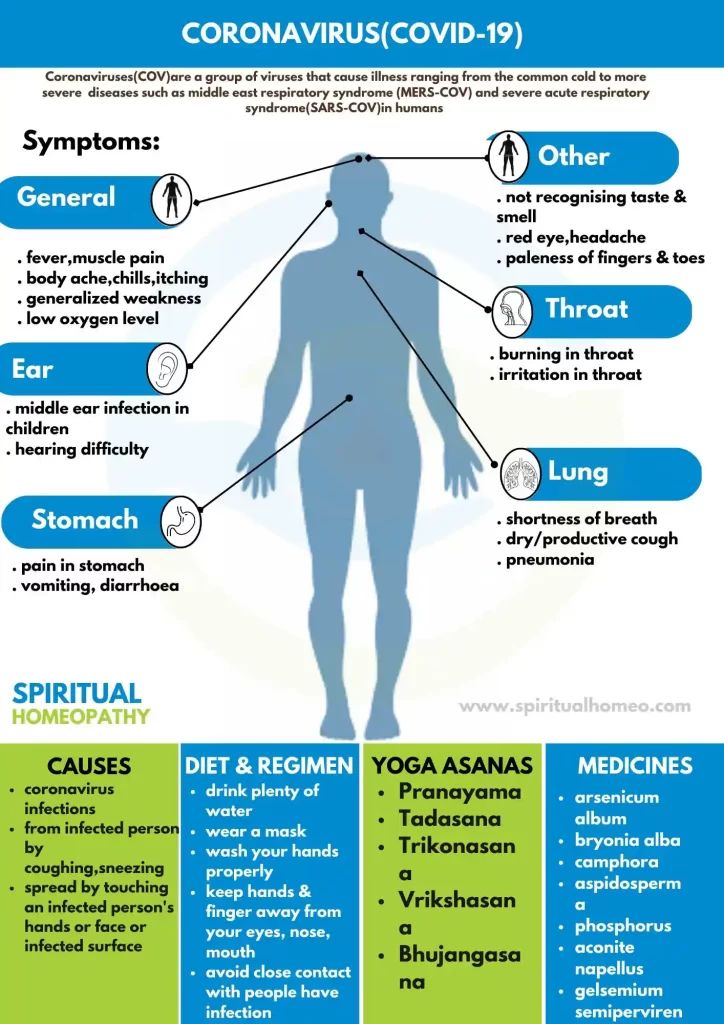
Coronavirus Disease (COVID-19) is a contagious viral respiratory illness caused by the SARS-CoV-2 virus. It can affect people of all age groups and may range from a mild illness to a severe infection. Common symptoms include fever, cough, sore throat, fatigue, body aches, loss of taste or smell, nasal congestion, and difficulty breathing. While many people recover with supportive medical care, some may develop serious complications such as pneumonia or experience lingering symptoms known as Long COVID, including persistent fatigue, breathlessness, brain fog, and weakness. Early diagnosis, appropriate medical treatment, vaccination, and timely medical attention remain essential to reduce complications and support recovery.
At Spiritual Homeopathy, we recognize that COVID-19 requires appropriate medical evaluation and treatment, and homeopathy is not a substitute for emergency care, antiviral treatment, or vaccination. However, following recovery from the acute infection, our experienced homeopathic doctors provide individualized supportive care by carefully evaluating each patient’s symptoms, medical history, immune status, energy levels, and overall health. Our holistic approach focuses on supporting the body’s natural recovery process, improving general well-being, enhancing immunity, managing lingering post-COVID symptoms, and promoting long-term health through safe and personalized homeopathic care. We offer supportive homeopathic care for post-COVID recovery, Long COVID symptoms, fatigue, and reduced immunity.
We provide personalized homeopathic supportive care for post-COVID recovery in Hyderabad through our clinics, along with online homeopathy consultations for patients across India and in more than 100 countries worldwide. If you are looking for the best homeopathy doctor for post-COVID recovery, supportive care for Long COVID, or holistic wellness after coronavirus infection, Spiritual Homeopathy is committed to delivering compassionate, patient-centered care that complements your ongoing medical treatment.
COVID-19, also known as Coronavirus Disease 2019, is a global infectious disease caused by the severe acute respiratory syndrome coronavirus 2 (SARS-CoV-2). The virus was first identified in Wuhan, China, in December 2019. The World Health Organization (WHO) declared the outbreak a Public Health Emergency of International Concern on January 30, 2020, and later classified it as a pandemic on March 11, 2020.
As of April 24, 2021, more than 145 million confirmed cases and over 3.08 million deaths had been reported worldwide, making COVID-19 one of the most significant public health challenges in recent history.
The term coronavirus is derived from the Latin word “corona” and the Greek word “κορώνη” (korṓnē), meaning garland or wreath. This refers to the crown-like appearance of the virus particles observed under electron microscopy.
Patients seeking medical guidance related to COVID-19 recovery or post-infection concerns can consult qualified professionals at Spiritual Homeopathy Clinic, with services available across Hyderabad branches, as well as through online and international consultations.
There are seven recognized strains of human coronavirus, including SARS-CoV-2. These include:
Human Coronavirus 229E (HCoV-229E)
Human Coronavirus OC43 (HCoV-OC43)
SARS-CoV (Severe Acute Respiratory Syndrome Coronavirus)
Human Coronavirus NL63 (HCoV-NL63), also known as New Haven coronavirus
Human Coronavirus HKU1 (HCoV-HKU1)
Middle East Respiratory Syndrome Coronavirus (MERS-CoV), previously known as novel coronavirus 2012 (HCoV-EMC)
Novel Coronavirus (2019-nCoV), now identified as SARS-CoV-2
The term novel indicates a newly identified virus and is used until a standardized scientific name is assigned.
Coronaviruses are zoonotic viruses, meaning they can be transmitted between animals and humans. Previous research has shown that SARS-CoV was transmitted from civet cats to humans, while MERS-CoV was linked to dromedary camels. Several coronaviruses continue to circulate among animals without causing human infection.
SARS-CoV-2, the virus responsible for COVID-19, shares genetic similarities with bat coronaviruses, pangolin coronaviruses, and SARS-CoV. Current scientific evidence supports a natural zoonotic origin, with bats considered a likely reservoir.
Ongoing research continues to improve understanding of transmission patterns, variants, and long-term health effects associated with COVID-19.
COVID-19 is caused by the SARS-CoV-2 virus, a type of coronavirus. While other coronaviruses are responsible for conditions ranging from mild illnesses like the common cold to more severe diseases such as SARS and MERS, SARS-CoV-2 has caused a widespread global pandemic.
Since the onset of the COVID-19 pandemic, new variants of the SARS-CoV-2 virus have emerged. These variants are slightly different versions of the original virus and may behave in distinct ways. Many of these variants are more contagious, meaning they spread more easily than the initial strain of the virus.
Although some concerns have arisen regarding the effectiveness of existing vaccines and treatments against newer variants, it is important to note that several variants have been observed to cause relatively less severe illness compared to the original strain, particularly in certain populations.
Notable variants of the SARS-CoV-2 virus include:
Alpha variant
Beta variant
Delta variant
Omicron variant
Understanding the nature of the virus and its variants helps healthcare professionals assess risk factors and plan individualized care approaches based on a person’s health status, exposure history, and symptom severity.
Coronaviruses are classified into four main subtypes: Alpha, Beta, Gamma, and Delta. Scientists use these classifications to group different strains of the virus based on their genetic structure and behavior.
Among the various types of coronaviruses, seven are known to affect humans. Four of these are common and usually cause mild illnesses involving the upper or lower airways, such as the nose, sinuses, throat, and lungs.
The remaining three coronaviruses are considered more severe and have been associated with major public health outbreaks. These include:
SARS-CoV: The virus responsible for the SARS epidemic in 2002–2003.
MERS-CoV: The virus that caused the MERS outbreak beginning in 2012.
SARS-CoV-2: The virus responsible for the global COVID-19 pandemic.
These strains are associated with a higher risk of severe respiratory illness, particularly in vulnerable individuals, and understanding their classification supports appropriate clinical assessment and individualized care planning.
The symptoms of COVID-19 can vary significantly, ranging from mild to severe illness. Common symptoms include:
Headache
Loss of smell and taste
Nasal congestion
Runny nose
Cough
Muscle pain
Sore throat
Fever
Diarrhea
Breathing difficulties
People with COVID-19 may experience different combinations of symptoms, and these symptoms may change or evolve over time. If symptoms are frequent, worsening, or severe, medical consultation is advised.
Three primary clusters of symptoms have been identified in people with COVID-19:
Respiratory Symptoms:
This cluster includes cough, sputum production, shortness of breath, and fever.
Musculoskeletal Symptoms:
This cluster includes muscle pain, joint pain, headache, and fatigue.
Digestive Symptoms:
This includes abdominal pain, vomiting, and diarrhea.
For individuals without prior ear, nose, or throat conditions, loss of taste and loss of smell is commonly associated with COVID-19.
81% of individuals develop mild to moderate symptoms, which may include mild pneumonia.
14% experience severe symptoms, such as dyspnea (difficulty breathing), hypoxia (low oxygen levels), or significant lung involvement.
5% of individuals experience critical symptoms, including respiratory failure, shock, or multiorgan dysfunction.
A significant number of people infected with COVID-19 may not develop noticeable symptoms. These asymptomatic individuals can still spread the virus, particularly if they are not tested. Others may be pre-symptomatic, showing very mild symptoms initially or developing symptoms later while remaining contagious.
There is typically a delay between exposure to the virus and the onset of symptoms. The median incubation period for COVID-19 is around four to five days, with most symptomatic individuals developing symptoms within two to seven days after exposure. Nearly all individuals experience at least one symptom within 12 days.
While most individuals recover from the acute phase of COVID-19, some continue to experience persistent effects, commonly referred to as long COVID. These may involve ongoing symptoms affecting multiple systems. Long-term studies are ongoing to better understand the extended health impact of the virus.
To support recovery and help manage symptoms of COVID-19, consider the following measures:
Drink plenty of water to stay hydrated and support normal body functions during illness.
Get adequate rest to allow the immune system to function effectively and support the recovery process.
Wash hands regularly with soap and water to reduce the risk of virus transmission and reinfection.
Keep hands away from the eyes, nose, and mouth to avoid transferring germs to these entry points.
Avoid close contact with individuals who are infected to limit further exposure.
Use a humidifier or take a steamy shower to help ease throat discomfort and provide moisture to the respiratory passages.
These general measures may help support recovery; however, dietary and regimen guidance can vary based on individual health status and symptom severity. Medical consultation is recommended if symptoms persist or worsen.
Benefits: Helps strengthen lung function, supports oxygen intake, and may assist in reducing stress and anxiety.
How to do it:
Sit in a comfortable position.
Close your right nostril with your right thumb and inhale slowly through the left nostril.
Close the left nostril with your ring finger and pause briefly.
Release the right nostril and exhale gently through the right side.
Continue for 5–10 minutes.
Benefits: Helps open the chest, supports respiratory capacity, and improves circulation.
How to do it:
Lie on your back with knees bent and feet flat on the floor.
Press your feet into the floor and lift your hips upward.
Keep shoulders grounded and arms relaxed by your sides.
Hold for 20–30 seconds, then slowly lower down.
Repeat 3–5 times.
Benefits: Helps stretch the chest and lungs, supports breathing, and strengthens the upper body.
How to do it:
Lie on your stomach with palms placed below the shoulders.
Slowly lift your chest by pressing the palms into the floor.
Keep elbows slightly bent and shoulders relaxed.
Hold for 15–30 seconds, then release.
Repeat 3–5 times.
Benefits: Improves posture, enhances body awareness, and supports balance and stability.
How to do it:
Stand upright with feet hip-width apart.
Engage the core and lengthen the spine.
Inhale and raise arms overhead.
Hold for 15–30 seconds with steady breathing.
Repeat 3–5 times.
Benefits: Helps reduce fatigue, supports circulation, and promotes relaxation.
How to do it:
Sit close to a wall and gently lift legs up against it.
Rest arms comfortably by your sides.
Remain in the pose for 5–10 minutes with slow, calm breathing.
Benefits: Supports lower body strength, improves circulation, and helps build stamina.
How to do it:
Stand with feet together.
Bend knees and lower hips as if sitting on an imaginary chair.
Keep spine straight and arms raised.
Hold for 15–30 seconds, then return to standing.
Repeat 3–5 times.
Benefits: Helps calm the nervous system, supports relaxation, and eases tension.
How to do it:
Kneel on the floor with knees comfortably apart.
Sit back on the heels and stretch arms forward.
Rest forehead on the floor.
Breathe deeply for 1–5 minutes.
Benefits: Supports lung capacity, promotes balance, and helps calm the mind.
How to do it:
Sit comfortably with the spine upright.
Close the right nostril and inhale through the left.
Close the left nostril, then exhale through the right.
Continue this cycle for 5–10 minutes.
Yoga and breathing practices may support recovery, reduce stress, and promote overall well-being. However, they are supportive measures only and should not replace medical care. Individuals experiencing persistent, severe, or worsening COVID-19 symptoms should seek professional medical guidance before continuing these practices.
At Spiritual Homeopathy Clinic, care is guided by traditional homeopathic principles along with an understanding of the physical and emotional aspects of health. The clinical team focuses on providing structured, patient-centered care that is tailored to individual health needs through careful evaluation.
The treatment approach is based on the view that health involves the interaction of physical, emotional, and lifestyle factors. Rather than focusing only on symptoms, consultations aim to understand contributing factors and overall health patterns. This supports an individualized care plan designed for long-term health management and balance.
Homeopathy consultations are conducted to review current symptoms, medical history, and lifestyle factors. Consultations are available at multiple branches in Hyderabad, as well as through online and international consultation options, allowing continuity of care for patients who cannot attend in person.
Care plans are developed on an individualized basis, considering symptom patterns and overall health status. Homeopathic care is generally well-tolerated when guided by a qualified professional and is used as part of a broader health management approach.
Follow-up consultations help monitor progress and make appropriate adjustments based on response and recovery patterns. Ongoing review supports continuity of care and addresses changes in health over time.
Spiritual Homeopathy Clinic emphasizes responsible, patient-focused care through professional consultation and follow-up. Individuals seeking guidance for specific health concerns or overall well-being are encouraged to consult a qualified practitioner for appropriate evaluation and advice.
You should consult a healthcare professional if COVID-19 symptoms become persistent, worsen, or begin to interfere with daily activities. Timely medical evaluation helps assess symptom severity, identify risk factors, and guide appropriate care.
Seek consultation if you experience:
Persistent or high fever
Worsening cough or breathing difficulty
Chest discomfort or tightness
Ongoing fatigue or weakness that limits daily activities
Loss of taste or smell lasting beyond the acute phase
Symptoms that do not improve with rest and supportive care
Any sudden or concerning change in symptoms
Individuals with existing medical conditions, older adults, or those recovering from COVID-19 should seek medical guidance if symptoms persist or recur.
At Spiritual Homeopathy Clinic, consultations are available across multiple branches in Hyderabad, including Kukatpally, Chandanagar, Dilsukhnagar, and Nallagandla. Online and international consultations are also available for patients who are unable to visit in person. Professional consultation supports an individualized care approach based on symptoms, recovery stage, and overall health status.
For appointments or consultation guidance, contact 9069 176 176.
Yes, COVID-19 continues to circulate globally as an endemic respiratory virus. While overall infection and hospitalization numbers generally remain low, new subvariants, such as the Omicron offshoots, occasionally drive localized increases in wastewater viral activity and case counts.
To beat COVID-19 as quickly as possible, contact a healthcare provider immediately to see if you are eligible for prescription antiviral medications like Paxlovid, which must be taken early. For mild cases, focus on maximizing your immune system with aggressive rest, staying hydrated, and using over-the-counter medications to manage symptoms.
Avoid crowds and close contact. Wear a properly fitted mask when physical distancing is not possible and in poorly ventilated settings. Clean your hands frequently with alcohol-based hand rub or soap and water. Cover your mouth and nose with a bent elbow or tissue when you cough or sneeze.
Yes, for the majority of people, COVID-19 heals on its own. Your immune system fights off the virus, with most mild or moderate cases clearing up within a few days to two weeks. Recovery primarily relies on your body's natural defenses, combined with home care like:
Lean chicken and turkey are good sources of protein. They're also good sources of zinc, a mineral that supports the immune system. Try chicken noodle soup with ginger and vegetable pieces in it—you'll increase your fluid intake and get immune-supporting nutrients. Eat foods with vitamin D.
The mRNA vaccines for COVID-19, which have now been administered several billion times, have been heavily scrutinized for safety and have been shown to be extremely safe, said Joseph Wu, MD, PhD, the director of the Stanford Cardiovascular Institute
WhatsApp us